Skip to content

Graduation Rates

Data and research reports

Graduation group with students in a row
 

Current Status: 94% - 4-year graduation 

The 4-year graduation rate is the percentage of students in a graduating class (cohort) who earned a high school diploma within four years of entering ninth grade. It is a measure of student success that helps us understand how many students are successfully completing high school.

The 5-year graduation rate is the percentage of students in a graduating cohort who earned a high school diploma within five years of entering ninth grade. It is a measure of student success that helps us understand how many students are successfully completing high school. The cohort represents 4 years from the beginning of 9th grade. 

A high school diploma is a standard requirement for most employment opportunities, as well as for enrollment in higher education. There is a strong connection between high school educational attainment and future health and economic outcomes. There are many factors at the individual, school, and community level that can impact a student’s ability to graduate and/or graduate on time. Graduation rates can serve as an indicator of the health of our local, state, and national systems that impact students and their ability to succeed.

The charts below present graduation rates for students belonging to different populations. The disparities seen in the charts highlight the need to reduce systemic inequality in educational opportunities.

Data dashboards

4-year graduation trends by race/ethnicity

The chart below reports the percentage of students who graduated from high school in 4 years by race/ethnicity since 2018. While some improvement in graduation rates is observed over time, particularly for Hispanic youth, disparities for Asian, Black, Hispanic, and Multiracial students compared to White students persist.

4-year graduation trends by gender

The chart below reports the percentage of students who graduated from high school in 4 years by gender since 2018. Overall, the 4-year graduation rate for male students is lower than for female students. The graduation rate for females has slightly but steadily increased over time while the rate for male students has remained relatively consistent.


4-year graduation rate trends-other data

The chart below reports the percentage of students who graduated from high school in 4 years by select demographic characteristics since 2018, including students experiencing economic disadvantage, English language learners (ELL), students experiencing homelessness, and students with disabilities. Each demographic group reports a 4-year graduation rate that is significantly lower than the county average.


4-year graduation rates - students included in yearly data 


The following chart shows the n-size for all students in the 4-year graduation data. 


5-year graduation trends by race/ethnicity

The chart below reports the percentage of students who graduated from high school in 5 years by race/ethnicity since 2017. While some improvement in graduation rates is observed over time, particularly for Hispanic youth, disparities for Asian, Black, Hispanic, and Multiracial students compared to White students persist.

5-year graduation trends by gender 

The chart below reports the percentage of students who graduated from high school in 5 years by gender since 2017. Overall, the 5-year graduation rate for male students is lower than for female students.

5-year graduation trends-other data 

The chart below reports the percentage of students who graduated from high school in 5 years by select demographic characteristics since 2017, including students experiencing economic disadvantage, English language learners (ELL), and students with disabilities. Each demographic group reports a 5-year graduation rate that is significantly lower than the county average.

5-year graduation rates - students included in yearly data

The following chart shows the n-size for all students in the 5-year graduation data.

Research reports and resources

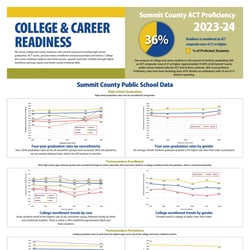
Thumbnail SEI_CollegeandCareer24_Poster_Final

College & Career Readiness

Get involved

SEI_WebsiteGraphics_CTASQuares_500x500_v1_UseOur-Data
SEI_WebsiteGraphics_CTASQuares_500x500_v1_ImpactPartner

Access our interactive dashboards to uncover trends, identify opportunity gaps and drive smart decision-making in your organization or school

Collaborate deeply with SEI and other cross-sector leaders to drive measurable change. Apply to become one of our High-Impact Partners.

SEI_WebsiteGraphics_CTASQuares_500x500_v1_ShareStory
SEI_WebsiteGraphics_CTASQuares_500x500_v1_StudentLeadership

Tell us your success story or innovative practice that’s making a difference for students and families so we can amplify what’s working across Summit County.

Districts can launch Students for Equity and Excellence (SEE) clubs. A leaders from each club serves on the countywide Youth Coalition. 

SEI_WebsiteGraphics_CTASQuares_500x500_v1_JoinYSS
SEI_WebsiteGraphics_CTASQuares_500x500_v1_Donate

Out-of-school time (OST) agencies can collaborate with OST providers on data-driven strategies for safe and engaging after-school programs. 

Support our programs, data tools and publications or sponsor events such as our annual fundraiser, workshops, forums or SCYC programs.